
Tech sales professionals in Denver typically earn a base salary between $54,000 and $110,000, with total on-target earnings (OTE) ranging from roughly $80,000 to $200,000 or more depending on role, seniority, and industry. An SDR just starting out can expect around $54,000 in base pay and ~$80,194 in total compensation according to Built In's Greater Denver data, while a mid-career Account Executive targeting enterprise deals often lands closer to $90,000 base and $160,000 OTE per RepVue's Denver figures. The gap between base and total comp is where the real story lives. Commission, accelerators, and bonuses can easily double a base salary in quota-driven roles, but only if the quota is actually achievable.
Data for this article draws from four primary public sources: Built In, RepVue, Glassdoor, and Comparably, supplemented by Orbyt and ZipRecruiter. Each platform measures slightly different things (self-reported vs. employer-submitted, base-only vs. total comp), so ranges across sources sometimes diverge by $20,000 or more for the same role.
- SDR/BDR base: ~$54,000; total comp: ~$80,000–$99,000
- Account Executive base: ~$90,000–$104,000; OTE: ~$160,000+
- Software Sales Rep total comp: ~$120,000
- Sales Engineer and Technical Sales: typically the highest base floors in the category
Key takeaways
Denver tech sales pay is highly role-dependent, and total compensation almost always matters more than base salary when evaluating or negotiating an offer.
| Point | Details |
|---|---|
| SDR base starts around $54,000 | Built In's Greater Denver data puts average SDR total comp at ~$80,194, with Comparably showing higher averages for more experienced SDRs. |
| AE OTE median is ~$160,000 | RepVue's Denver data shows a $90,000 median base and $160,000 median OTE; top performers reach well above $300,000. |
| OTE beats base as a negotiation lever | Always confirm quota attainment history and accelerator thresholds — a high OTE with low historical attainment is often unreachable. |
| Industry and company stage shift pay significantly | Enterprise SaaS and aerospace roles typically pay more than early-stage startups or professional services, even for the same title. |
| Colorado's 4.4% flat income tax improves net pay | Compared to high-bracket states, Denver's flat rate meaningfully increases take-home on the same gross OTE. |
Table of Contents
- Denver tech sales salaries by role: SDR, AE, Sales Engineer, and more
- How total compensation is built in Denver tech sales
- How experience and seniority shift pay in Denver
- How company size, industry, and employer type affect pay in Denver
- Benefits, equity, and non-cash compensation in Denver tech sales
- Where these numbers come from
- How to evaluate and negotiate a Denver tech sales offer
- What Denver tech sales pay patterns actually mean for your career
- Where to check live Denver pay data
- Sources
Denver tech sales salaries by role: SDR, AE, Sales Engineer, and more
The table below reflects 2026 salary data aggregated from Built In, RepVue, Glassdoor, Orbyt, and Comparably for the Greater Denver area. "Total comp" includes base plus commission, bonus, and other variable pay. Ranges reflect approximately the 25th–75th percentile band where data is available.
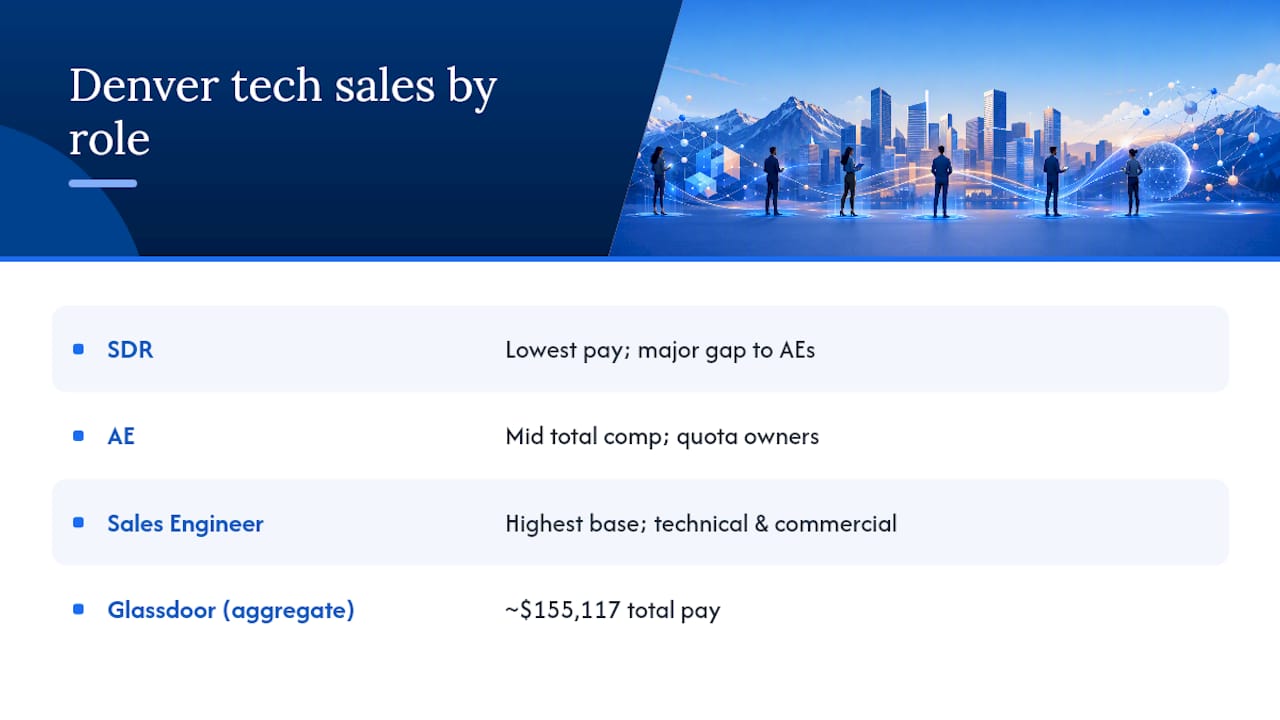
Glassdoor's aggregate Denver tech-sales figure of ~$155,117 in total pay sits comfortably in the middle of the AE and Technical Sales bands, which makes sense: that aggregate blends multiple seniority levels. The SDR-to-AE gap is the most dramatic jump in the table, and it reflects a structural difference, not just experience. AEs own quota on closed revenue; SDRs own pipeline generation. Deal size, sales cycle length, and the revenue risk an employer assigns to each role drive the OTE split.
Sales Engineers sit at the top of the base-salary range because they carry both technical depth and commercial accountability. A company selling complex infrastructure or SaaS to enterprise buyers needs someone who can run a proof-of-concept and close, and that combination commands a premium.
How total compensation is built in Denver tech sales
Base salary is the floor, not the ceiling. In quota-driven roles, the variable component, which includes commission, bonuses, and sometimes equity, can represent 30–60% of total comp
The core components:
- Base salary: Fixed annual pay, paid regardless of quota performance. Typically set at 50–70% of OTE for AE roles; higher as a percentage for SDRs.
- Commission: A percentage of revenue closed or pipeline generated, paid monthly or quarterly. Common structures include a flat rate on ARR (annual recurring revenue) or a tiered rate that increases once quota is exceeded.
- OTE (On-Target Earnings): The total you'd earn if you hit 100% of quota. This is the number to negotiate, not just base.
- Accelerators: Commission multipliers that kick in above quota. A rep hitting 120% of quota might earn 1.5x their standard commission rate on the overage. This is where top earners separate from the pack.
- Bonuses: Quarterly or annual cash tied to team, company, or individual milestones. Less predictable than commission.
- Equity: RSUs or stock options, more common at growth-stage and public companies. Vesting schedules typically run 4 years with a 1-year cliff.
The most common trap in tech sales offers is a wide OTE paired with a quota that almost nobody hits. Orbyt's Denver AE data makes this point directly: OTE matters more than base alone, but only if the quota is realistic. Understanding how companies calculate variable pay helps you spot the difference between a real earning opportunity and a number on paper.
Pro Tip: Before accepting any offer, ask three questions: What percentage of reps hit 100% of quota last year? What does the accelerator structure look like above quota? And when are commissions paid — monthly or quarterly? Those three answers tell you more about real earning potential than the OTE figure itself.
Commission timing matters more than most candidates realize. A quarterly payout schedule means you could work three months before seeing variable pay. If you're coming from a monthly-pay role, that cash-flow gap is real.
How experience and seniority shift pay in Denver
Entry-level SDRs and mid-career AEs occupy very different compensation worlds, and the jump between them is not purely linear.
The jump from SDR to AE is the single biggest compensation step in a tech sales career. A rep who spends 12–18 months as an SDR, builds a track record of quota attainment, and moves into a closing role can more than double their total comp. That transition is also where understanding the SDR vs. BDR distinction matters: BDRs focused on outbound enterprise accounts often command slightly higher bases than inbound-focused SDRs, because the role demands more autonomous prospecting judgment.
Moving from mid-level AE to senior or enterprise AE is less about years and more about documented overperformance. ZipRecruiter's Denver AE data attributes much of the variance in AE pay to candidates' ability to demonstrate quota attainment history and negotiate OTE structure. A rep with two consecutive years at 120%+ of quota has real leverage. One with spotty attainment, even at a senior title, does not.
The $160,000 OTE median for Denver AEs from RepVue is a useful benchmark, but it represents the midpoint of a wide distribution. The 25th percentile sits meaningfully below that; the 90th percentile pushes well past $300,000 for enterprise roles.
How company size, industry, and employer type affect pay in Denver
Not all Denver tech sales jobs pay the same, even for identical titles. Industry vertical and company stage are often bigger pay drivers than years of experience.
- Enterprise SaaS companies (public or late-stage private) typically offer the highest OTE floors, structured commission plans, and equity. Roles at companies in the $100M+ ARR range often come with quota sizes of $1M+ and commission rates that make hitting $200,000+ OTE realistic.
- Early-stage startups (Series A/B) frequently offer lower base salaries offset by equity upside. The trade-off is real: a $70,000 base at a pre-IPO company with meaningful equity could outperform a $95,000 base at a mature company over a 4-year horizon, or it could be worth nothing.
- Aerospace and defense-adjacent tech companies in the Denver/Colorado Springs corridor often pay higher base salaries with lower variable components. Deal cycles are long, procurement is complex, and commission structures reflect that.
- Telecom and infrastructure sales roles (think companies in the Cisco/RingCentral ecosystem) tend to offer mid-to-high bases with structured commission plans tied to contract value and renewal rates.
- Professional services firms selling technology consulting typically pay lower OTE than pure SaaS but offer more predictable commission tied to project close rates. Sales development consulting firms in Colorado follow a similar pattern.
When reading a job posting, watch for quota size relative to OTE. A $150,000 OTE with a $2M quota at a 7.5% commission rate is straightforward math. A $150,000 OTE with no quota disclosed is a red flag worth probing before the offer stage.
Benefits, equity, and non-cash compensation in Denver tech sales
Total reward extends well beyond base and commission. For Denver-based roles, a few benefits categories have an outsized effect on real take-home value.
- Health insurance: Employer-paid premiums are common at mid-to-large tech companies. A plan where the employer covers 80–100% of individual premiums is worth $5,000–$10,000 annually compared to a role where you pay most of the premium yourself.
- 401(k) match: Standard at established tech employers, typically 3–6% of salary. A 4% match on a $90,000 base is $3,600 per year in additional compensation that rarely shows up in OTE discussions.
- PTO and flexibility: Unlimited PTO policies are common in Denver tech, though actual usage varies. Structured PTO (15–20 days) with clear carryover rules is often more valuable in practice.
- Sign-on bonuses: Increasingly common as a tool to bridge the gap between what a company will pay in base and what a candidate needs. Typically $5,000–$25,000 for AE-level roles, sometimes structured as a clawback if you leave within 12 months.
- Equity (RSUs and options): RSUs at public companies have clear value; options at private companies require more scrutiny. Ask about the strike price, the last 409A valuation, and the preferred stock overhang before assigning value to options.
For a Denver AE earning $180,000 in total comp, that flat rate means a lower marginal tax burden than the same role in California or New York, which affects net take-home in a way that doesn't show up in gross OTE comparisons.
Where these numbers come from
Every figure in this article comes from one of five public salary platforms. Each measures something slightly different, and knowing the difference matters when you're benchmarking an offer.
- Built In (builtin.com): Separates base salary from additional cash compensation, which makes it one of the cleaner sources for understanding the base/variable split. The SDR data and Software Sales Rep data used here come from Built In's Greater Denver pages. Sample sizes for some role/location pairs are small; check the sample count before citing a number.
- RepVue: Focuses on sales-specific roles and collects verified data from sales professionals. Strong for AE and quota-carrying roles. The Denver AE figures include OTE breakdowns and top-end outliers, which most platforms don't show.
- Glassdoor: Large sample sizes for aggregate views, but self-reported and sometimes blends seniority levels. Best for directional benchmarks and total comp ranges rather than precise role-level figures.
- Comparably: Useful for bonus data and total compensation averages. The Denver SDR figure of ~$99,073 is notably higher than Built In's, likely because Comparably's sample skews toward more experienced SDRs or includes roles that other platforms classify differently.
- Orbyt and ZipRecruiter: Good for cross-checking AE ranges and understanding negotiation context. Orbyt's Denver AE median of ~$104,000 differs from RepVue's $90,000 median, reflecting different sample compositions.
Always check the date and sample size fields on any salary page before using a number in a negotiation. A figure based on 12 self-reported salaries from 2023 is not the same as one based on 400 verified submissions from the past six months.
How to evaluate and negotiate a Denver tech sales offer
Most candidates leave money on the table because they negotiate base when they should be negotiating OTE structure, quota size, and accelerators.
- Confirm the full OTE breakdown. Ask for the base/variable split in writing. A $160,000 OTE with a 50/50 split means $80,000 base; with a 60/40 split it means $96,000 base. That difference affects your floor if you have a slow quarter.
- Ask for historical quota attainment data. "What percentage of reps on this team hit 100% of quota last year?" is a fair and standard question. If the answer is below 50%, the OTE is largely theoretical.
- Understand the accelerator structure. Find out at what percentage of quota accelerators kick in and what the multiplier is. This is where top earners make their real money.
- Benchmark against live data. Pull current figures from RepVue, Built In, and Orbyt for your specific role before the negotiation conversation. Use percentile data, not just medians.
- Negotiate non-cash items if base is fixed. Sign-on bonus, quota relief in the first 90 days, and an earlier performance review are all negotiable even when base is locked.
- Factor in Colorado's 4.4% flat income tax. When comparing offers across states, the net-pay difference can be significant. A $170,000 OTE in Denver often nets more than the same number in a high-bracket state.
- Check pipeline management fundamentals to understand how quota design connects to realistic attainment before you commit to a number.
Pro Tip: If an employer won't share historical attainment rates, that silence is data. Healthy sales organizations are proud of their attainment numbers. Ones that deflect the question usually have a reason to.
Here's a short email template you can adapt when requesting OTE clarification before accepting an offer:
That message is direct, professional, and signals that you understand how sales compensation works, which itself is a positive signal to a hiring manager.
What Denver tech sales pay patterns actually mean for your career
The salary data tells one story; the career trajectory tells another. Denver's tech sales market rewards the SDR-to-AE transition faster than most candidates expect, and it punishes staying in an SDR role too long. The median SDR total comp of roughly $80,000–$99,000 is solid for an entry-level role, but an AE at the same company earning $160,000 OTE is doing so with a skill set that's only 18–24 months ahead on the closing side.
The roles that scale fastest in Denver are enterprise AE and Sales Engineer. Both require technical fluency, and both command the upper end of the compensation bands in this article. An AE who can run a technical discovery, speak credibly to a CTO, and manage a complex multi-stakeholder deal is worth significantly more than one who relies on a solutions engineer for every demo. That skill gap is also where AI-powered sales coaching is changing the development curve, compressing the time it takes to build technical credibility.

My honest read on this market: most candidates undervalue their negotiating position because they anchor on base salary instead of OTE structure and quota design. The base is the least interesting number in a tech sales offer. What matters is whether the quota is achievable, whether the accelerators are real, and whether the company has a track record of paying them out. Get those answers before you sign anything.
Where to check live Denver pay data
Salary figures shift as hiring markets move. Before any negotiation, pull current numbers from at least two of these sources and compare.
- Built In Greater Denver: Best for separating base from additional cash compensation; check the sample size field on each role page.
- RepVue Denver AE page: Best for OTE breakdowns, top-end outliers, and quota-carrying roles specifically.
- Glassdoor Denver tech sales: Best for aggregate total comp ranges; useful for directional benchmarks but check whether the sample blends seniority levels.
- Orbyt Denver AE: Good cross-check for AE base ranges; emphasizes that OTE context matters more than base alone.
- Comparably Denver SDR: Useful for bonus data and total compensation averages for SDR roles.
- ZipRecruiter Denver AE: Helpful for understanding base salary variance and the role negotiation plays in where candidates land.
Always note the date and sample size on any page you use. A figure from a small or outdated sample can send you into a negotiation with the wrong anchor. For deeper context on how to build a career in Denver tech sales or to explore consulting and leadership opportunities in Colorado, visit Chadburmeister or browse the sales and AI books that cover compensation strategy, pipeline growth, and B2B sales leadership in depth.
Sources
- 2026 Sales Development Representative Salary in Greater Denver Area | Built In
- Account Executive Salaries in Denver, CO (June 2026) | RepVue
- Salary: Tech Sales in Denver, CO | Glassdoor