Four frameworks cover almost every cold email situation you'll face: PAS for problem-led outreach, PASO for a slightly softer version of the same, BAB for outcome-driven pitches, and AIDA for warmer audiences who already know your name. None of them matter much without one habit: a research-grade opening line and a body that stays inside a typical word count range that balances detail with brevity. Frameworks like PAS, PASO, BAB, and AIDA are useful scaffolding, but personalization is the actual driver of reply rates, not the acronym you picked.
Chad Burmeister has spent more than 25 years building and scaling sales development teams at companies like Informatica, RingCentral, and Cisco-WebEx, and he's written nine books on sales strategy, several of them specifically on AI-driven outreach. That's the lens for what follows: not theory, but the structures and habits that hold up when you're sending hundreds of emails a week and need a meaningful set of them to land a reply.
This guide walks through each core framework with a copy-ready example, breaks down the anatomy of a high-reply email line by line, hands you templates for first touches and follow-up sequences, and flags the mistakes that quietly kill response rates. Read it in order or jump to the section you need.
Key Takeaways
Cold email frameworks like PAS, PASO, and BAB work best as scaffolding, but a research-grade opener and a 75 to 125 word structure are what actually drive reply rates.
| Point | Details |
|---|---|
| Pick a framework by warmth | Use PAS or PASO for cold, unaware prospects; BAB for transformation pitches; AIDA only for warmer, already-engaged audiences. |
| Respect the word count | Keep first-touch emails between 75 and 125 words, with five parts: subject, opener, value bridge, proof, ask. |
| Personalize the opener, not the template | Use a recent signal, peer comparison, or content callback instead of a tokenized first-name merge field. |
| Build a real follow-up sequence | Run three to five touches, put your strongest proof point on touch three, and always include a breakup email. |
| Get outside help when execution stalls | Chad Burmeister offers fractional leadership, a structured curriculum, and books for teams whose reply rates have plateaued despite knowing the frameworks. |
Table of Contents
- Core Cold Email Frameworks and When to Use Each
- What a High-Reply Cold Email Is Built From
- Templates and Sequences You Can Use This Week
- Mistakes That Quietly Kill Reply Rates
- Practitioner Notes on Applying Frameworks at Scale
- What I'd Test First If I Were Rebuilding a Sequence
- Get Hands-On Help Implementing These Frameworks
- Frequently Asked Questions
- Sources
Core Cold Email Frameworks and When to Use Each
Every framework is really just a different order of the same four ingredients: a problem, a benefit, evidence, and a request. What changes is emphasis and tone. Pick based on how much your prospect already knows about their problem and how warm the relationship is.
1. PAS (Problem, Agitate, Solution)
One-line definition: Name the problem, make it sting a little, then hand over the fix.
Best when: Your prospect probably hasn't fully diagnosed the cost of the issue you're pitching.
Main risk: Agitation that reads as manipulative or exaggerated kills trust fast, especially with senior buyers who've seen the trick before.
Example:
- Problem: "Most RevOps teams I talk to are still manually tagging intent signals in a spreadsheet."
- Agitate: "That usually means reps chase the wrong 20 accounts while the real buyers go cold."
- Solution: "We built a way to auto-rank accounts by buying signal strength in under a minute. Worth a look?"
2. PASO (Problem, Agitate, Solution, Outcome)
One-line definition: PAS with a tangible result tacked on at the end.
Best when: Your buyer is data-driven and wants proof before they'll book fifteen minutes.
Main risk: Tacking on a number without context ("40% improvement") reads as vague marketing filler if you don't say improvement in what, over what timeframe.
Example:
- Problem: "Your SDR team posted three new job listings this month."
- Agitate: "Hiring is expensive when ramp time eats the first 90 days."
- Solution: "Our fractional leadership model gets new reps to quota in half that time."
- Outcome: "One client cut ramp time from 90 days to 45."
3. BAB (Before, After, Bridge)
One-line definition: Paint the current state, paint the better state, then explain the bridge between them.
Best when: You're selling a transformation or a strategic shift, not a tactical fix.
Main risk: The "after" picture can sound aspirational and fluffy if it's not tied to something the prospect actually said or did recently.
Example:
- Before: "Right now your outbound reps probably spend 20 minutes per prospect researching before they write anything."
- After: "Top teams get that down to under two minutes without losing the personal touch."
- Bridge: "That's the gap our AI-assisted research workflow closes. Open to seeing how?"
4. AIDA (Attention, Interest, Desire, Action)
One-line definition: The classic marketing structure, adapted for warmer B2B audiences who've had some prior exposure to your brand.
Best when: The prospect downloaded a resource, attended a webinar, or engaged with content, so you're not a total stranger.
Main risk: AIDA assumes some baseline interest already exists. Use it on a cold, unaware audience and it reads like an ad, not an email from a person.
Example: "Saw you grabbed our AI for Sales playbook last week. Most teams who read it ask the same question: how do you personalize at scale without burning hours per lead? Happy to walk you through the three-tier system we use. Fifteen minutes this week?"
Three more structures worth knowing
- 3Ps (Praise, Picture, Push): Compliment something specific and real, paint a picture of the improved state, then push for a small next step. Works well for account-based outreach to named executives.
- Intent-based framework: Lead entirely with a trigger event (funding round, new hire, tech stack change) instead of a problem statement, then connect that event directly to your offer.
- Share-asset framework: Offer something of immediate value, a benchmark report, a template, a relevant case study, with no ask attached to the first email at all. The ask comes on touch two.
Pro Tip: Write each beat of a framework as one sentence, no more. If your "agitate" line needs three sentences to land, the problem itself probably isn't specific enough yet.
Practical templates and worked examples for each of these structures matter more than memorizing the acronyms; seeing how each framework plays out in a real email is what actually helps a team standardize on one.
What a High-Reply Cold Email Is Built From
Strip away the framework labels and a high-performing cold email is really five parts stacked in order: subject line, opener, value bridge, proof, and ask. Practitioner data across large-scale sending programs points to a consistent structure: a five-part anatomy of subject, opener, value bridge, proof, and ask, with total length landing between 75 and 125 words.
That range isn't arbitrary. Too few words often fail to convey sufficient information to earn a reply, while too many words may overwhelm a cold recipient. A separate breakdown of the same structure recommends 50 to 90 words for a first touch, stretching to 125 only when the personalization actually earns the extra length.
Here's the breakdown with micro-guidelines for each part:
- Subject line. subject lines that are short and specific, generally under about 60 characters. Specific beats clever. "Question about your Q1 hiring push" beats "Quick question!" every time.
- Opener. a single sentence. Its entire job is proving you did research on this specific person or company, not their industry in general.
- Value bridge. One to two sentences connecting what you noticed to a benefit that's relevant to their role, not a generic feature list.
- Proof. a single sentence, one data point or named comparable. A specific number beats a vague claim every time.
- Ask. a single sentence, one clear action. "Worth 15 minutes Thursday?" beats "Let me know your thoughts."
Openers that beat the first-name trick
Tokenized personalization, merge fields that swap in a first name or company name, reads as automation now because it is automation, and prospects know it. Three patterns consistently outperform it: a recent signal, a peer comparison, or a content callback.
- Recent signal: "Noticed you posted three SDR roles this month." Ties directly to something that just happened.
- Peer comparison: "Two other Series B fintech companies I work with hit this same wall around 50 reps." Uses a comparable company's experience as the hook.
- Content callback: "Saw your comment on [name]'s post about pipeline coverage ratios." References something the prospect actually said or did publicly.
The strongest personalization move in the entire framework is that opening sentence proving genuine research; it's the single element that makes any structure convert.
Personalizing at scale without burning your whole week
You can't spend 30 minutes researching every one of 500 prospects, so match your research depth to deal size. A tiered workflow is the standard fix: Tier 1 gets 30-plus minutes, Tier 2 gets around 10, and Tier 3 relies on trigger-event or AI-assisted personalization done in 30 to 90 seconds.
- Tier 1 (30+ minutes): Enterprise accounts, named executives. Read their recent LinkedIn posts, check earnings calls if public, note specific initiatives.
- Tier 2 (~10 minutes): Mid-market accounts. Scan the company's recent news, check job postings, glance at their tech stack.
- Tier 3 (30 to 90 seconds): High-volume outreach. Feed an AI tool a recent trigger event, a job change, a funding announcement, a tech install, and let it draft the opener for review.
AI only helps here when it's fed real inputs. Feeding it generic prompts produces generic openers; feeding it 30 days of LinkedIn activity or company news produces something that actually reads like a human wrote it.
Follow-up cadence and reply handling
Most high-reply programs run three to five touches. Touch three tends to carry the most weight because it's where you can drop your strongest proof point, often a named comparable with a specific metric attached. And the breakup email, the one that says "should I close this out?", is often the second-highest reply driver in the entire sequence, right behind the first touch.

On the reply side: treat your SLA the same way you'd treat an inbound lead. A reply sitting unanswered for a day is a meeting you're statistically less likely to book. Route replies to whoever's fastest, not whoever sent the original email.
Templates and Sequences You Can Use This Week
Copy these, swap in your own specifics, and cut anything that doesn't apply to your buyer. Every template respects the 75 to 125 word range unless noted.
1. PAS first-touch template
Subject: Manual list building at [Company]?
"Noticed [Company] posted for two SDR roles this month. Most teams scaling that fast end up drowning reps in manual prospecting before they've even hit quota. We built a system that cuts research time per lead from 20 minutes to under two, without losing the personal touch. Worth 15 minutes to see if it fits your ramp plan?"
2. PASO first-touch template
Subject: Ramp time at [Company]
"Saw you're hiring three reps this quarter. New hires typically take 90 days to hit quota, and that gap is expensive at scale. Our fractional leadership model shortens that window significantly by fixing the onboarding process itself, not just adding headcount. One client cut ramp time from 90 days to 45. Open to a quick call?"
3. BAB first-touch template
Subject: From 20 minutes to 2
"Right now your reps probably spend real time per prospect just researching before they write a single line. The teams that get ahead cut that down to a couple of minutes without sounding like a template. That's the gap an AI-assisted research workflow closes. Want to see how it works?"
4. Three-touch follow-up mini-sequence
- Value-add touch (Day 3): Share a relevant benchmark or short case study with no direct ask.
- Proof-point touch (Day 7): Reference a specific comparable client and a real metric, then repeat the original ask in one sentence.
- Breakup email (Day 14): "Haven't heard back, so I'll assume the timing's off. If this becomes relevant later, just reply and I'll pick it back up."
Sample sequence by tier:
- Tier 1 (enterprise): Five touches over three weeks. Personalized opener referencing a specific initiative, proof point tied to a named comparable competitor, phone touch inserted at day 10.
- Tier 2 (mid-market): Four touches over two weeks. Company-level personalization, one proof point, one breakup email.
- Tier 3 (volume): Three touches over 10 days. Trigger-event opener generated with AI assistance, one generic-but-relevant proof point, fast breakup.
Formatting matters as much as wording. Send first touches in plain text, no HTML, no tracking pixels, since plain-text emails without links generally outperform link-heavy ones for both deliverability and trust. If you're sending at real volume, route mail through a secondary domain rather than your primary one, protecting your main domain's sending reputation while you test.
Pro Tip: Keep a swipe file of every reply-generating opener your team writes. After 50 sends, patterns emerge that no framework can predict on paper.
Teams running templated customer outreach at scale in other service industries face the same tension between speed and personalization; structured response templates for services businesses show the same principle at work outside of pure cold outreach.
Mistakes That Quietly Kill Reply Rates
- Generic opener. "Hope this finds you well" tells the prospect you know nothing about them. Fix: lead with a specific signal instead.
- Feature dump. Listing five product capabilities in one email overwhelms rather than persuades. Fix: pick the single benefit most relevant to this buyer.
- Email runs too long. Anything over 150 words asks too much of a cold reader. Fix: cut to the 75 to 125 word range and read it aloud.
- Vague subject line. "Quick question" gets ignored or filtered. Fix: name the specific topic in three to seven words.
- Links in the first touch. Links trigger spam filters and signal a sales pitch before the prospect's read a word. Fix: no links until at least touch two.
- No follow-up plan. One email and done wastes the entire effort of the first touch. Fix: build a three to five touch sequence before you send anything.
- Slow reply handling. A day of silence after a reply can cost the meeting. Fix: set a same-day SLA for anyone who responds.
Five-minute audit: Check word count (under 125?), check the opener (does it prove research, or could it apply to anyone?), check the ask (one clear action, or three vague ones?).
Practitioner Notes on Applying Frameworks at Scale
The acronym you choose matters less than most sales blogs claim. What separates a 2% reply rate from an 8% one is almost always the specificity of that opening line and whether the follow-up cadence actually gets built, not which of the four letters in PASO get used first.
Twenty-five-plus years spent scaling SDR and BDR teams at companies like Informatica, RingCentral, and Cisco-WebEx teaches you that frameworks fail in execution, not in design. Most teams need one of two things: a fractional leader who's built these systems before, or a structured curriculum that gets internal reps executing consistently. Coaching existing SDRs works when the team already has decent research habits; bringing in outside leadership works faster when the whole motion needs rebuilding from scratch.
Pro Tip: If your team's reply rate has been flat for two full quarters, the fix is rarely a new template. It's almost always the research step getting skipped under deadline pressure.
What I'd Test First If I Were Rebuilding a Sequence
If you only change one thing this week, change the opener. Pick 20 prospects, write a genuine research-grade first sentence for each using the recent-signal pattern, and run it against your current template as a straight A/B split. The framework underneath, PAS, BAB, whichever, matters far less than whether that first line proves you did the work.

Test it, track the replies, and adjust the follow-up cadence based on what you learn. The podcast covers deeper operational breakdowns of exactly this kind of testing if you want to go further.
Get Hands-On Help Implementing These Frameworks
Reading about frameworks and running them at scale under quota pressure are two different problems. If your team already knows the theory but the reply rates still aren't moving, that's usually an execution gap, not a knowledge gap, and it's the kind of gap fractional leadership or a structured curriculum closes faster than another round of internal coaching.
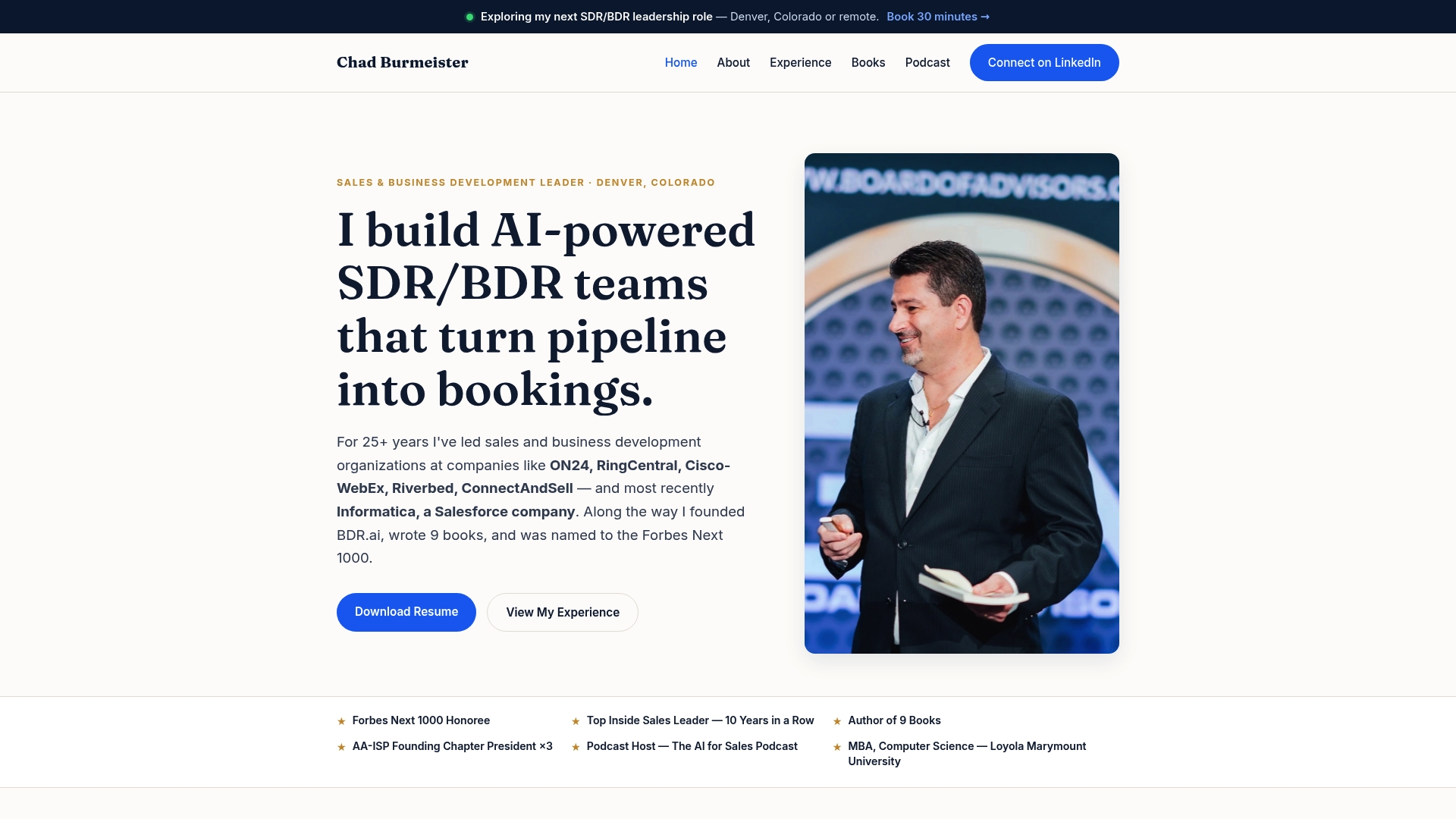
Chad Burmeister works directly with CEOs, CROs, and founders who need SDR and BDR teams performing at a higher level without a full-time executive hire. That includes hands-on fractional leadership engagements, the Be Extraordinary curriculum for teams that want a formal training track their reps can run through on their own schedule, and books like AI for Sales 2.0 for anyone who wants the frameworks and the AI-assisted workflows in one place.
If you're not sure which fits your situation, the fastest next step is booking a conversation through the main site to talk through where your current sequences are breaking down.
Frequently Asked Questions
What is the best cold email framework to start with?
PAS (Problem, Agitate, Solution) is the most practical starting point for cold, unaware prospects because it doesn't assume any prior familiarity with your brand. PASO adds an outcome statement for buyers who want proof before they'll engage.
How long should a cold email be?
Most high-reply cold emails fall between 75 and 125 words, with some practitioner data suggesting 50 to 90 words as the tighter first-touch target unless heavy personalization justifies the extra length.
How many follow-ups should a cold email sequence include?
a sequence of several follow-ups typically between three and five is standard. Put your strongest proof point on the third touch and close the sequence with a breakup email, which typically performs as the second-best reply driver after the first touch.
Should I include links in my first cold email?
No. Plain-text first touches without links or tracking pixels tend to outperform link-heavy emails on both deliverability and prospect trust. Save links for the second or third touch.
How do I personalize cold emails without spending hours on each one?
Use a tiered approach: spend 30-plus minutes on high-value enterprise accounts, about 10 minutes on mid-market accounts, and rely on AI-assisted trigger-event personalization, done in 30 to 90 seconds, for high-volume outreach.
Sources
- Cold Email Personalization Frameworks: PASO, PAS, BAB and When to Use Each | EmailToolsHub
- How to write cold emails that work in 2026 · ReachIQ
- How to Write a Cold Email: The 5-Part Structure That Books B2B Meetings | Snipe Outbound
- How to write cold emails that work · ZoomInfo pipeline
- 7 Cold Email Frameworks That Work in 2026 (With Examples) — Clearout