Cold email deliverability, for a CEO or CRO, has nothing to do with SPF records or spam folders. It means whether your outreach actually reaches the right person with the right message at the right moment, measured in replies, meetings, and pipeline. The single highest-leverage fix is signal-based personalization: targeting prospects based on something real happening in their world right now. Teams that adopt it push reply rates from a 3.43% average to 12–18%, a bigger swing than any subject-line tweak will ever produce.
TL;DR:
- Focusing on signal-based personalization and precise targeting significantly increases reply rates, often tripling them compared to generic approaches.
- Weekly monitoring of reply rate, bounce rate, and sending hygiene, combined with verified lists, is crucial to maintaining deliverability and campaign effectiveness.
- Clear, trigger-specific templates, tight follow-up sequences, and multichannel outreach are proven to recover and boost reply rates.
- Proper domain authentication, list hygiene, and reputation management are fundamental to avoid deliverability issues beyond message content.
- Leading with ownership and a structured, 90-day pilot approach accelerates SDR performance and prevents common operational failures.
Table of Contents
- What Should Leaders Stop Doing to Fix Cold Email Deliverability?
- Why Does ICP Precision Beat List Size Every Time?
- Which Prospect Signals Actually Raise Reply Rates?
- What Follow-Up Cadence Actually Recovers Replies?
- How Does Multichannel Outreach Lift Reply Rates?
- What KPIs Should Leaders Actually Track Weekly?
- What Does a 90-Day Cold Email Pilot Look Like?
- Do SPF, DKIM, and DMARC Still Matter for Cold Email?
- What Causes Cold Email Deliverability Problems Beyond Copy and Targeting?
- What Best Practices Protect Sender Reputation Long-Term?
- How Do You Monitor and Fix Deliverability Problems as They Happen?
- Leadership actions that unlock SDR performance
- Want an Expert-Led Pilot Instead of Building This Internally?
- Sources
What Should Leaders Stop Doing to Fix Cold Email Deliverability?
Open rates stopped meaning much the moment Apple rolled out Mail Privacy Protection, which pre-fetches and pre-opens messages regardless of whether a human ever looks at them. That single change quietly broke the metric most sales dashboards were built around. If your weekly report still leads with "open rate," you're steering by a broken compass, and reply rate and click rate are the metrics worth trusting now.
Most SDR programs waste effort chasing the wrong fixes. Stop funding these:
- Rewriting subject lines instead of fixing who gets emailed
- Writing longer, more "persuasive" pitches instead of shorter, sharper ones
- Buying bigger lists to compensate for weak targeting
- Treating SPF, DKIM, and DMARC configuration as the growth lever, when it's simply table stakes
Copywriting and technical setup matter, but they're subordinate to targeting, signals, and sequence design. Fix the order of operations before you fix the words.
Why Does ICP Precision Beat List Size Every Time?
Smaller, tightly matched lists consistently outperform bulk sends. Campaigns targeting 50 or fewer recipients average a 5.8% reply rate, while sends scaled past 1,000 recipients fall to roughly 2.1%. Volume dilutes relevance, and relevance is the entire game.
Precision requires operational discipline most teams skip. Before any send:
- Re-verify the list within 30 days of launch, not at quarter start
- Keep bounce rate under 2% during ramp, and pause immediately if you cross it
- Enforce suppression rules for unsubscribes and prior opt-outs without exception
- Assign one owner for list hygiene, not a rotating cast of SDRs
Deliverability, in the technical sense, is an infrastructure state you build and monitor, not a switch you flip once. Warm domains gradually, verify before every batch, and treat a rising bounce rate as a stop signal, not background noise.
Pro Tip: Give one person ownership of list verification with a documented handoff to the SDR team. When ownership is shared across five reps, nobody actually checks the list before it goes out.
Which Prospect Signals Actually Raise Reply Rates?
Not all signals are equal, and they decay fast. Treat this as a shelf-life problem, not a data problem.
- Public posts and comments — usable for about 48 hours before the reference feels stale
- Job changes — relevant for roughly 90 days after the move
- Funding announcements — a window of 2 to 8 weeks before every competitor has already mentioned it
- Active hiring for relevant roles — act within 4 weeks, ideally immediately
Signal-based personalization only scales when you bind a small set of templates to clear trigger categories instead of writing from scratch every time. Build 4 to 5 templates, each tied to one trigger type, with just 1 or 2 variable slots (name, specific detail). More variables slow reps down without adding much lift.
Keep the message itself tight. Emails under 80 words with one clear call to action consistently beat longer pitches, and a low-friction ask ("worth a 15-minute call?") outperforms an open-ended one every time.
Pro Tip: Write your subject line referencing the trigger, not your product. "Saw the Series B" gets opened. "Boost your sales pipeline" gets deleted.
What Follow-Up Cadence Actually Recovers Replies?
Roughly 42% of all replies come from follow-ups, not the first email. Reps who send one message and move on are leaving nearly half their pipeline on the table.
A cadence that works without feeling like nagging:
- Day 1: Initial signal-based email, under 80 words, one CTA
- Day 3: A value-add follow-up. Share a relevant stat, a short case reference, or a resource. Never just "bumping this up."
- Day 7: A brief check-in that references the original trigger again, since it's likely still fresh
- Day 14: A breakup email that gives the prospect a clean exit, which often gets the highest reply rate of the whole sequence
Every touch needs new information. Repeating the same pitch four times reads as pressure, not persistence. Build in branching logic too: pause the sequence the moment a prospect engages in any way, and cap active prospects per rep at 200 to 300 so quality doesn't erode as volume climbs.
How Does Multichannel Outreach Lift Reply Rates?
Email alone leaves reply rates capped lower than they need to be. Coordinated sequences across email, LinkedIn, and phone commonly produce 8–15% reply rates, often 2 to 3 times what email-only campaigns deliver.
A five-step sequence that works without feeling scattered:
- Engage with a prospect's LinkedIn post or comment first
- Send an email referencing that specific engagement, not a generic opener
- Call with context from both touches already established
- Send a LinkedIn connection request once there's a reason for it
- Follow up by email again, still tied to the original signal
The lift comes from recognition, not repetition. A prospect who sees your name across two channels in one week assumes you did homework, not that you're running a bot. Automate the scheduling of each step, but hard-code one rule into the workflow: any reply, on any channel, pauses everything else immediately.
What KPIs Should Leaders Actually Track Weekly?
Positive reply rate is the headline number, and everything else supports it. For well-targeted B2B outbound, a healthy reply rate sits around 5–7%, with anything above 8% suggesting strong product-market fit and anything under 3% flagging a targeting or list problem, not a copywriting one.
Benchmark to anchor your dashboard: Reply rate above 8% signals top-quartile targeting; below 3% means something upstream is broken, not the subject line.
Track these weekly, not monthly:
- Positive reply rate (primary KPI)
- Bounce rate, held under 2%
- Meeting-booked rate, which should land at 20–40% of positive replies
- Reply sentiment, not just reply count
Open rate has become noise since Apple Mail Privacy Protection started pre-fetching messages regardless of human interest. Use seed-inbox placement tests instead to verify where your emails are landing.
Run tests properly: change one variable per campaign, wait for a real sample size before drawing conclusions, and hold a weekly review where the team looks at the numbers together. That operational discipline of testing one thing at a time and enforcing kill rules is what compounds small wins into a predictable pipeline.
What Does a 90-Day Cold Email Pilot Look Like?
A short pilot beats an open-ended overhaul because it forces decisions instead of endless debate.
- Month 1 (data collection): Set warm-up posture on a secondary sending domain, define one ICP with one trigger type, build a list of 200 verified prospects, and write 3 signal-linked templates. Keep 15% of sending volume as permanent warm-up traffic even after ramp.
- Month 2 (iteration): Launch the multichannel cadence, run weekly variable tests, and track reply rate against the 5–7% benchmark.
- Month 3 (scale): Expand to additional ICP segments only after the first segment clears benchmark, and document what worked before scaling headcount or volume.
Governance matters as much as the plan itself. Run a weekly KPI review with the campaign owner, set kill rules for any template or channel underperforming after two full weeks, and document every change so the next quarter doesn't repeat the same experiments blind.
Pro Tip: Resist the urge to scale in Month 1. A pilot that stays small and precise for 30 days will out-perform one that gets rushed to volume before the signal-to-template match is proven.
Do SPF, DKIM, and DMARC Still Matter for Cold Email?
Yes, but they're the floor, not the strategy. SPF (Sender Policy Framework), DKIM (DomainKeys Identified Mail), and DMARC (Domain-based Message Authentication, Reporting, and Conformance) are authentication records that tell receiving mail servers your domain is who it claims to be. Without them properly configured, mailbox providers have a legitimate reason to flag or reject your messages before a prospect ever sees the subject line.
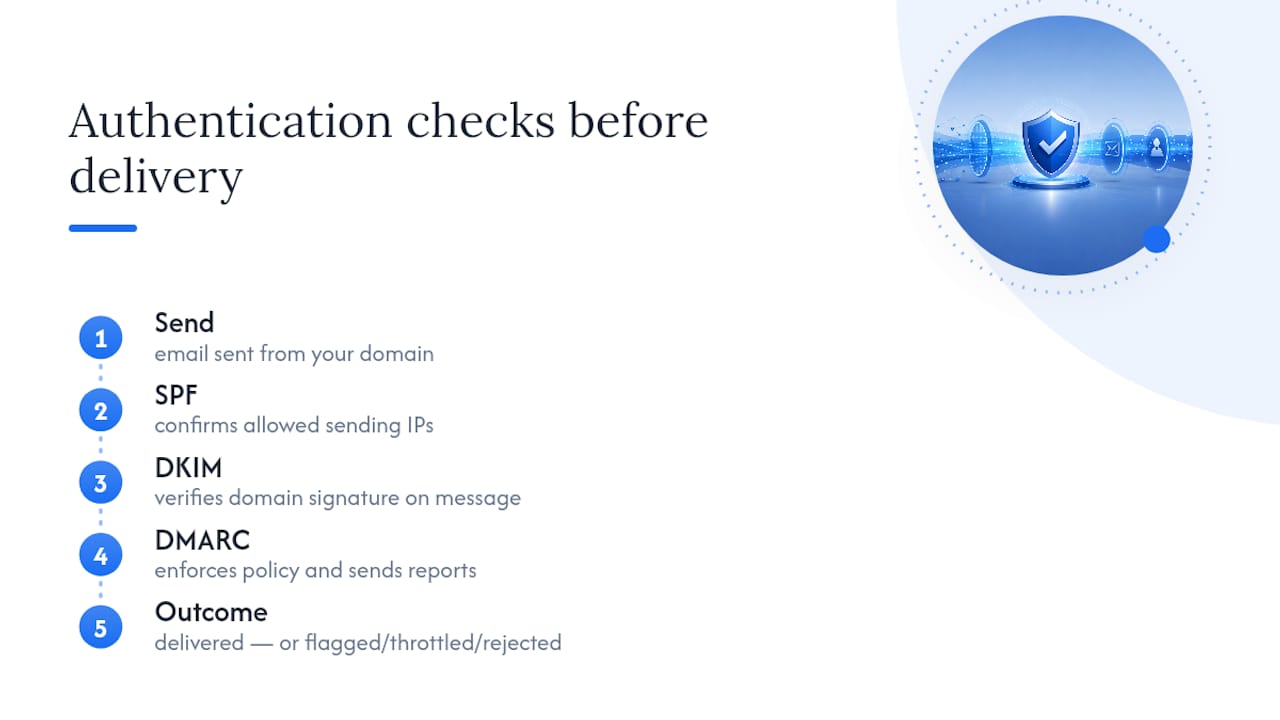
Here's the distinction leaders miss: fixing SPF, DKIM, and DMARC doesn't raise your reply rate. It just removes a ceiling that would otherwise cap your reply rate at zero. Think of it like a delivery truck's registration. Having valid plates doesn't sell the product inside the truck, but driving without them means the truck never leaves the lot.
Where this connects back to outreach effectiveness: a domain with weak authentication records often gets throttled or filtered inconsistently, which shows up in your data as a mysteriously low reply rate with no obvious targeting problem. If your signal-based personalization is sharp and your reply rate still sits under 3%, check authentication configuration before you rewrite another template. A domain with solid SPF, DKIM, and DMARC records, combined with a gradual warm-up period, gives your targeting and sequencing work an actual chance to show results instead of getting lost in a spam folder before a human ever opens it.
Most email service providers and outreach platforms will flag misconfigured records automatically now, so this is rarely a manual audit. It's a "check the dashboard once a quarter" task, not a daily concern for a sales leader.
What Causes Cold Email Deliverability Problems Beyond Copy and Targeting?
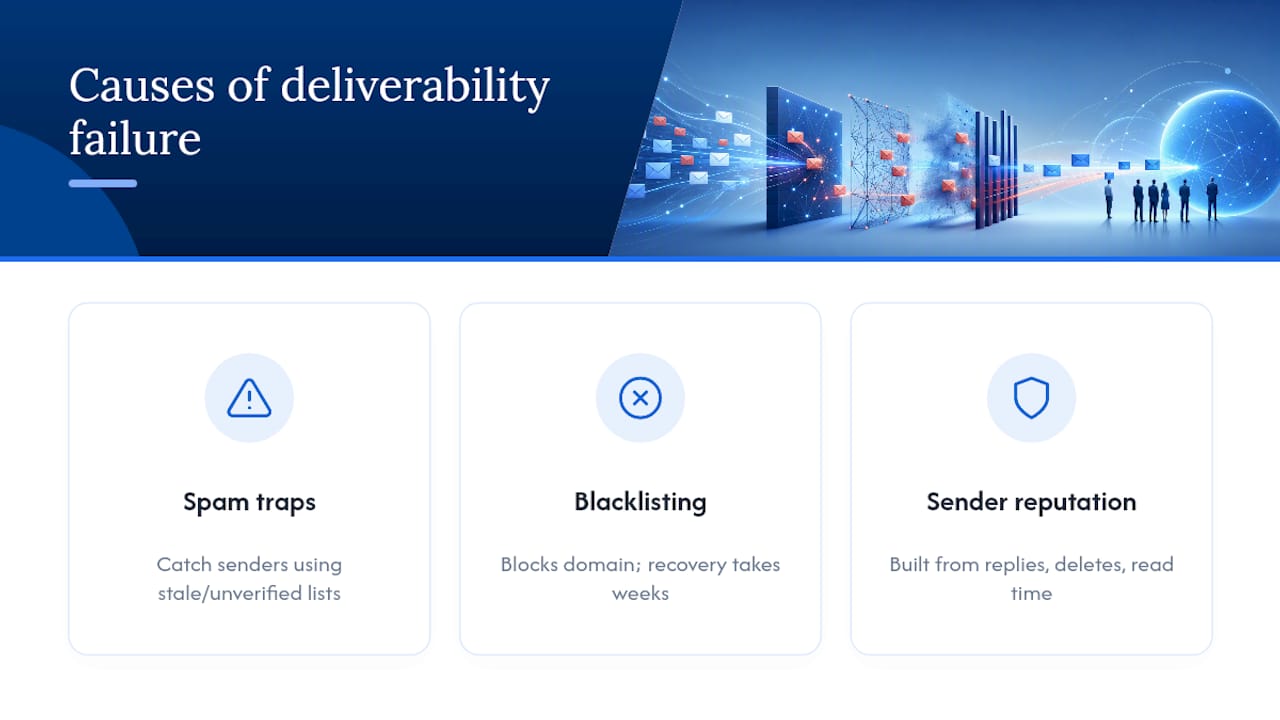
Three operational failures quietly tank programs that otherwise have solid targeting and messaging: spam traps, blacklisting, and sender reputation decay.
Spam traps are email addresses mailbox providers plant specifically to catch senders with poor list hygiene. They look like normal addresses, but nobody ever reads them. Hit enough of them by emailing stale, unverified, or purchased lists, and providers start treating your entire domain with suspicion. This is exactly why re-verifying lists within 30 days of a send matters more than most SDR teams realize.
Blacklisting happens when enough recipients mark your messages as spam, or when spam-trap hits accumulate past a threshold. Once a domain lands on a major blacklist, deliverability across every campaign drops, not just the offending one. Recovery can take weeks even after you fix the underlying behavior.
Sender reputation is the quiet variable behind both problems. Mailbox providers track how recipients interact with your domain over time, replies, deletions, spam reports, and even how long people spend reading before archiving. A domain with strong reputation gets more benefit of the doubt when volume increases. A damaged one gets filtered by default, regardless of how good your signal-based targeting is.
The common thread: all three trace back to list quality and sending discipline, not copywriting. This is why validating lists before every send and monitoring bounce rate isn't a nice-to-have step buried in an appendix. It's the difference between a program that scales and one that quietly degrades every month.
What Best Practices Protect Sender Reputation Long-Term?
Sender reputation builds slowly and erodes fast, so the practices that protect it need to be habits, not one-time fixes.
Warm up gradually. New domains or newly ramped sending volume need a slow build, typically starting at low daily volume and increasing over several weeks. Skipping this step is the single fastest way to trigger provider filtering before your first real campaign even launches.
Segment your sending volume. Spreading cold outreach across a primary domain and a secondary sending domain isolates risk. If one domain takes reputation damage from a bad list or an aggressive send, it doesn't drag down the domain your customer-facing team relies on for support and billing emails.
Monitor engagement, not just delivery. Replies, forwards, and time spent reading all signal to providers that real humans want your mail. Consistently low engagement, even without spam complaints, can quietly suppress future deliverability.
Keep bounce rate under 2% as a hard rule, not a guideline. Anything higher during a ramp period should stop the campaign immediately, not just trigger a note for next week's review.
Respect suppression lists without exception. Every unsubscribe, every opt-out, every bounce needs to leave the active list permanently. Re-adding a contact because a rep "thought they might be interested again" is one of the fastest ways to trigger a spam complaint that damages the whole domain's reputation.
How Do You Monitor and Fix Deliverability Problems as They Happen?
Detection has to happen faster than the damage compounds. That means checking specific signals weekly, not waiting for a quarterly review to notice reply rates have quietly collapsed.
Watch bounce rate first. Catching it in week one is far cheaper than discovering it after a month of damaged sends.
Run seed-inbox tests regularly. Sending test messages to accounts you control across Gmail, Outlook, and other major providers shows you where messages actually land, inbox, promotions, or spam, independent of what open-rate data claims. This is the most reliable substitute for the open-rate metric that Apple Mail Privacy Protection broke.
Track reply sentiment alongside reply count. A rising reply rate built on angry "remove me" responses isn't a win. Sentiment tells you whether your targeting is actually working or just annoying more people faster.
When a problem surfaces, isolate the variable before reacting. Check list source and verification date first, since that's the most common root cause. Then check domain authentication status, then sending volume trends. Fixing the wrong variable wastes a testing cycle you don't have time to spare in a 90-day pilot.
Leadership actions that unlock SDR performance
Most SDR programs don't have a messaging problem. They have an ownership problem. After 25 years scaling sales and business development teams at companies like Informatica, RingCentral, and Cisco-WebEx, and after publishing frameworks in books like AI for Sales 2.0, the pattern repeats: reply rates stall when no single leader owns the campaign end-to-end.
Fractured ownership is the real blocker. One person builds the list, another writes copy, a third manages the sequence tool, and nobody owns the reply-rate number itself. Misaligned KPIs make it worse: SDRs get measured on activity volume while leadership wants pipeline, and those two goals actively fight each other.
Fix it at the leadership level, not the SDR level. Fund a real 90-day pilot instead of an indefinite "let's improve outreach" initiative. Assign one campaign owner with authority over list, copy, and cadence together.
— Chad
Want an Expert-Led Pilot Instead of Building This Internally?
Building the system above internally takes real bandwidth: an ICP owner, a list verification process, template testing, and weekly KPI reviews that actually happen. An expert-led 90-day pilot is offered as an alternative to hiring and training that infrastructure from scratch, built around diagnosis, execution, and either a clean handoff or ongoing retained support.
Expect specific deliverables, not vague coaching. That means a defined ICP and trigger set, verified prospect lists, signal-linked templates, a multichannel cadence, and a weekly KPI review built around reply rate, not open rate. Governance stays simple: one owner, one dashboard, one kill-rule process for anything underperforming. If you'd rather see the thinking in writing first, the books on sales and AI cover the same frameworks in depth. To scope a pilot for your team, start a conversation about your program directly.
Sources
For deeper implementation detail, see The Cold Email Frameworks That Actually Get Replies and the email list validation process for cutting bounce rates under 2%. For AI-assisted scaling of personalization, review AI Cold Email for Marketers and Sales Pros and proven strategies for growing a targeted list.
- How to Improve Your Cold Email Response Rate in 2026 | Getcleed
- Cold Email: The Complete B2B Guide to Booking Meetings in 2026
- Apple Mail Privacy Protection: What Still Works for Senders