A channel sales strategy uses third-party partners, resellers, distributors, or affiliates, to sell your product instead of relying only on an in-house sales team. Choose it when partners can reach buyers you cannot reach efficiently, or when you need to expand coverage without adding headcount at the same rate as revenue. The tradeoff is real: margin compression, less control over the customer relationship, and a partner base that can go cold fast without deliberate enablement.
TL;DR:
- Building a successful channel program requires a clear thesis identifying coverage gaps, accurate unit economics, and a manageable partner tier structure.
- Focus on recruiting partners with existing relationships and proven commitment, while avoiding overextending with too many or irrelevant logos early on.
- The first 90 days of onboarding, including training and the first co-sell, are crucial for partner activation and long-term success.
- Prioritize active, committed partners by tracking activation rates, time to first deal, and revenue concentration to manage program health and reduce risk.
- Scaling a channel program should follow structured stages, with governance rules like deal registration and offboarding to maintain control as the program matures.
Table of Contents
- What Is Channel Sales, and How Does It Differ From Direct Sales?
- What Types of Sales Channels Should You Consider?
- Is Channel Sales the Right Move for Your Business Right Now?
- How Do You Build a Channel Sales Strategy From Scratch?
- How Do You Recruit and Qualify the Right Channel Partners?
- What Happens in the First 90 Days of Partner Onboarding?
- How Should You Structure Partner Incentives and Pricing?
- What KPIs Actually Predict a Healthy Channel Program?
- How Do You Scale a Channel Program Without Losing Control?
- What Templates and Tools Help You Track Partner Activity?
- Should You Go Channel-First or Direct-First?
- Where to Get Expert Help Building Your Channel Program
- Where to Go for More on Channel Program Design
- Sources
What Is Channel Sales, and How Does It Differ From Direct Sales?
Channel sales means a third party, not your own employees, closes the deal or influences it heavily enough to earn a cut. Common partner types include value-added resellers, distributors, system integrators, referral partners, and affiliates who send leads for a fee. Direct sales keeps everything in-house: your reps own the pipeline, the pricing conversation, and the relationship from first touch to renewal.
The difference isn't just who signs the contract. It's who owns the customer.
- Control: Direct sales gives you full visibility into every conversation; channel sales hands that visibility to a partner who may or may not report accurately.
- Margin: Direct deals keep the full margin; channel deals share it through commissions, discounts, or referral fees.
- Relationship ownership: In channel deals, the partner often owns the day-to-day relationship, which can complicate renewals, upsells, and support escalations.
Three common scenarios: a software company lets regional system integrators bundle its product into larger implementation projects; a hardware manufacturer sells through distributors who already have warehousing and logistics in a country it doesn't operate in; a SaaS company pays consultants a referral fee for introductions they'd otherwise never source themselves.
What Types of Sales Channels Should You Consider?
Not every partner model fits every product. The right one depends on deal complexity, geographic reach, and how much hand-holding a sale requires.
- Resellers and VARs buy at a discount and resell, often bundling in services. They fit complex products that need local customization or support.
- Distributors hold inventory and manage logistics across a region. They fit physical products or software sold through hardware channels, especially where you lack local infrastructure.
- System integrators embed your product into larger client projects. They fit enterprise software with heavy implementation work.
- Referral and affiliate partners send warm introductions for a fee, without taking on delivery or support. They fit lower-complexity products with a fast sales cycle.
- Platform and marketplace partners list you inside an ecosystem buyers already trust (an app marketplace, a cloud provider's catalog). They fit products that solve a narrow, well-defined problem inside a bigger workflow.
A ten-person startup selling a plug-in tool usually starts with affiliates or marketplace listings, since indirect sales lets a company expand reach without hiring proportionally. A company selling six-figure enterprise contracts in unfamiliar geographies leans toward distributors or system integrators instead, because those partners already carry the local trust and technical depth a cold outbound team would take years to build.
Is Channel Sales the Right Move for Your Business Right Now?
Before recruiting a single partner, run this checklist:
- Do you have a repeatable sales process? If your own reps still improvise every deal, a partner has nothing reliable to replicate.
- Does your margin support a partner cut? If commissions or discounts wipe out profitability, fix pricing first.
- Can you name five companies that would want to sell for you? If you can't picture the partner, you can't design the program around them.
Three red flags argue against launching now: your product changes shape every quarter, your onboarding takes weeks of hand-holding even for direct customers, or your average deal size is too small to justify a partner's time. If any of those apply, wait and fix the underlying issue.
If the checklist passes, run a pilot with a handful of partners before building a full program. Waiting costs you market share to competitors already recruiting partners in your space; rushing costs you a reputation for a program that doesn't deliver, which makes future recruitment harder.
How Do You Build a Channel Sales Strategy From Scratch?
Start with a channel thesis, not a partner list. Write down exactly which coverage gap partners fill: geographies you can't staff, verticals where a partner's existing trust beats your cold outreach, or deal sizes too small for a direct rep's time. If you can't articulate the gap in one sentence, the program will drift.
Next, model the unit economics. Calculate partner acquisition cost, activation cost, commission cost, and retention cost before signing anyone, because these figures determine which partner archetypes are sustainable at scale. A referral partner with a 10% fee and no support burden looks very different, economically, from a reseller who needs deep technical enablement and a dedicated partner manager.
Design tiers early: a simple two or three tier structure (registered, certified, premier) tied to volume or certification keeps incentives clear as the roster grows.
Build a one-page joint business plan (JBP) template for every partner. It should include:
- A 12-month revenue target
- Five to ten named target accounts
- Who owns each next step
- Required enablement and support
- Dates of the next three review meetings
Pro Tip: Draft the JBP template before you recruit a single partner. Handing a partner a finished document on day one signals seriousness, and it gives you a structured way to hold them accountable without the conversation feeling like a scorecard.
Launch with five to ten partners, not fifty. A small first cohort lets you fix onboarding gaps, pricing confusion, and messaging problems before they compound across a larger roster.
How Do You Recruit and Qualify the Right Channel Partners?
Recruitment goes wrong when leaders chase logos instead of fit. Build an Ideal Partner Profile (IPP) based on traits you've actually observed driving activation, not aspirational ones: existing relationships in your target vertical, a sales team incentivized to sell adjacent products, and a track record of following through on partner commitments with other vendors.
Recruit partners as relationships, not signatures. A shorter roster of committed partners consistently outperforms a long list of signed-but-dormant logos, because dormant partners still cost you enablement time and reporting overhead without producing revenue.
Before signing, ask for an early commitment that predicts real intent:
- A named list of target accounts they'll bring to the first joint business plan
- A dedicated point of contact on their side, not a shared inbox
- A specific date for their first co-sell activity
Evaluate every prospective partner against three questions: Do they already sell to your buyer? Does their margin math work with your commission structure? Will their team actually show up for enablement sessions? A partner who fails the third question rarely activates, no matter how attractive their customer list looks on paper.
What Happens in the First 90 Days of Partner Onboarding?
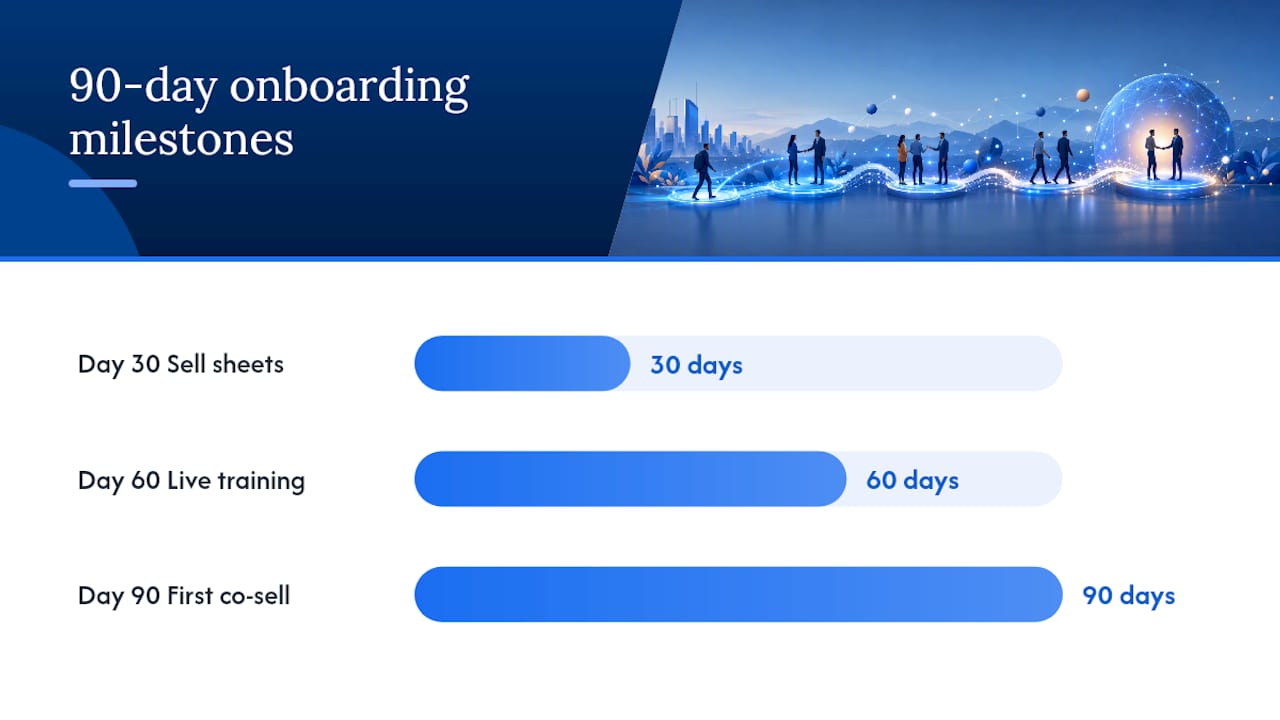
Enablement, not signing, determines whether a partner ever closes a deal. Front-loading effort in the first 90 days is the single strongest predictor of long-term activation, according to the Vx Group's research on B2B channel programs.
- Day 30: Deliver sell sheets, finalized pricing, and named contacts on both sides. The partner should never have to guess who to call.
- Day 60: Run live training and at least one joint demo with a real prospect, not a practice account.
- Day 90: Push for a first co-sell, even a small one. A first deal, however modest, builds the muscle memory for every deal after it.
Required enablement assets include sell sheets, call scripts, objection handlers, and a demo deck the partner can present without your team in the room. Indirect sales programs need this kind of partner-facing collateral plus a regular communication rhythm to keep partners engaged past the honeymoon period.
Pro Tip: Set a recurring "office hours" block, even 30 minutes weekly, where partners can drop in without scheduling a formal call. The partners who show up unprompted are usually the ones who activate fastest.
How Should You Structure Partner Incentives and Pricing?
Commission structures generally fall into three buckets: flat referral fees for introductions, tiered commissions that scale with deal size or partner certification level, and co-sell splits where your rep and the partner's rep both touch the deal.
- Referral fees work best for low-touch introductions where the partner does little beyond the intro.
- Tiered commissions reward partners who invest in certification and deeper product knowledge.
- Co-sell splits fit complex deals where both sides bring something the other lacks.
Model margin impact before finalizing any structure. A commission that looks generous on a single deal can quietly erode profitability once volume scales.
Money isn't the only lever. Early access to new features, co-marketing budget, and public recognition (a partner spotlight, a joint case study) often move committed partners more than an extra percentage point of commission, especially once a partner's core economics already work.
What KPIs Actually Predict a Healthy Channel Program?
Two numbers matter more than any others early on: activation rate and time to first deal. Define an active partner as one who quoted or ordered within the last 90 days, an approach detailed in Allego's guide to building channel partner programs. Anything longer than 90 days without activity is a signal to intervene, not wait.
Track these on a simple scorecard:
- Activation rate (percentage of signed partners who are active)
- Time to first deal from signing
- Partner-sourced revenue versus partner-influenced revenue
- Partner concentration, meaning how much revenue sits with your top three partners
Watch the concentration number closely. Programs where the top three partners generate more than 60% of channel revenue carry serious risk if even one of those partners leaves or gets acquired. A monthly scorecard review with each active partner, and a quarterly review of the aggregate dashboard with leadership, keeps small problems from becoming program-wide ones.
How Do You Scale a Channel Program Without Losing Control?
Programs tend to move through five stages: architecture, validation, operations, optimization, and maturation. Skipping a stage, jumping straight from a five-partner pilot to a hundred-partner rollout, is where most channel programs break.
- Architecture: Define the thesis, tiers, and unit economics.
- Validation: Run the small cohort and confirm activation rates hold up.
- Operations: Hire a dedicated partner manager once you cross roughly 15 to 20 active partners.
- Optimization: Invest in a PRM (partner relationship management) system once manual tracking in spreadsheets starts producing conflicting numbers between your team and partners.
- Maturation: Formalize governance.
Governance rules matter more as the roster grows. Deal registration prevents two partners from chasing the same account. Clear account ownership rules prevent your direct sales team from competing with the same partners you're paying to sell. Sunset rules, a defined process for offboarding dormant partners, keep the roster honest instead of bloated with names that never activated.
What Templates and Tools Help You Track Partner Activity?
A working joint business plan needs concrete numbers, not vague goals: a 12-month revenue target, five to ten named target accounts, clear ownership of next steps, listed support requirements, and three scheduled review dates. Vague JBPs get signed and then ignored; specific ones get referenced in every partner call.
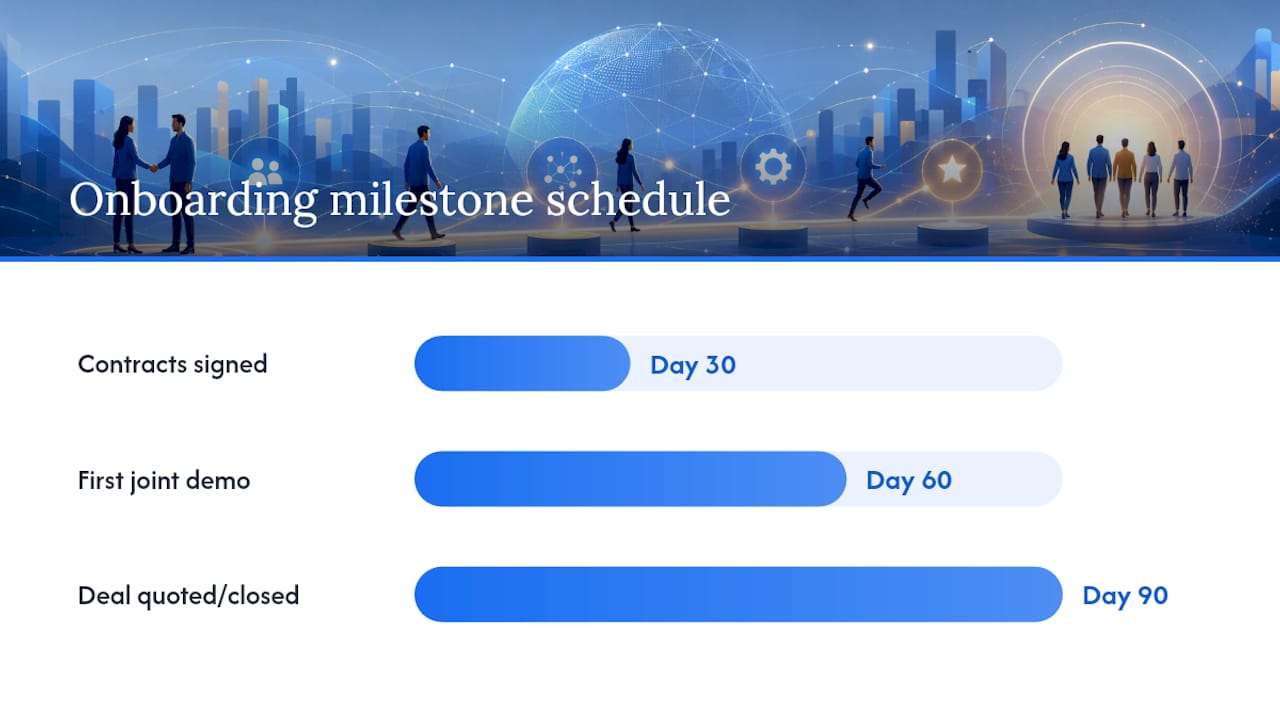
Run onboarding against a real checklist:
- Day 30: contracts signed, pricing delivered, contacts named on both sides.
- Day 60: first joint demo completed with a live prospect.
- Day 90: first deal quoted or closed.
Apply the same deal-intelligence discipline to partners that you'd apply to your own reps. Use AI-powered tools to flag partners who've gone quiet, no quotes, no activity, past the 90-day threshold, before they officially churn. The same signals your internal pipeline tools surface for your own team, deal stage stalls, no recent activity logged, missed follow-ups, apply just as well to a partner account. Waiting for a quarterly business review to discover a cold partner means you've already lost three months you could have used to intervene.
Should You Go Channel-First or Direct-First?
Channel-first makes sense when partners already own trust with your buyer that you'd take years to build alone. It backfires when your product still changes shape monthly, because partners can't sell what they can't predict. My honest read: most companies should prove the offer with a small direct motion first, then layer channel on top once the pitch, pricing, and onboarding are stable enough for someone else to replicate. Pilot with five partners for one full quarter before committing executive budget to a larger build.
— Chad
Where to Get Expert Help Building Your Channel Program
Building this out well takes time most sales leaders don't have alongside a full quota and a direct team to run. An experienced sales leader brings decades of scaling sales and business development teams at companies like Informatica, RingCentral, and Cisco-WebEx into hands-on leadership engagements, workshops, and consulting focused specifically on partner enablement and pipeline growth.
If your team needs a structured JBP framework, a 90-day enablement sequence, or someone to run point on channel partner management while you focus on direct revenue, start a conversation about a sales leadership engagement to explore what a working program can look like inside your business. For leaders who want to work through the frameworks themselves first, Books on related topics walk through partner economics and enablement sequencing in more depth than any single article can, available on the books page. Co-marketing questions, joint launches, and partner-branded campaigns often benefit from outside brand strategy support as well. This is where a partner like Align's B2B execution work fits into the picture.
Where to Go for More on Channel Program Design
For deeper reading on program architecture and risk tradeoffs, see ForEntrepreneurs' breakdown of channel sales risk, HubSpot's primer on indirect sales, and CinnaLab's staged maturity model for partner programs.
Sources
- Channel Sales — For Entrepreneurs
- Indirect sales explained — HubSpot
- Channel Sales Strategy for B2B Companies | Vx Group
- Channel sales — Allego (blog)