Account prioritization is a living, CRM-first score that ranks accounts by fit, buying signals, and engagement, not a static list you build once a quarter. The action to take today: pull that score into your CRM, cap Tier 1 at a number your reps can actually work, and set alerts so stacked signals surface the moment they happen instead of during next month's pipeline review.
TL;DR:
- Effective account prioritization should continuously update based on signals and engagement, rather than rely on static lists built months ago.
- Combining three key layers—fit, buying signals, and engagement—on a normalized scale improves accuracy over relying on one factor alone, especially when weighted appropriately.
- Building a reliable scoring system involves thorough data audits, clear factor definitions, normalization, tier mapping, and regular recalibration aligned with actual deal outcomes.
- Promoting transparent CRM integration and real-time alerts encourages daily rep use, reinforced by explaining the reasoning behind each ranking to increase trust.
- Top teams track metrics such as conversion rate by tier, time-to-first-touch, and renewal lift, adapting weights based on actual closed-won data to ensure ongoing model effectiveness.
Table of Contents
- What Is Account Prioritization, Really?
- The Three-Layer Framework: ICP Fit, Buying Signals, and Engagement
- How Do You Build an Account Scoring System Step by Step?
- What Signals Actually Predict Buying Momentum?
- How Do You Get the Score Into Reps' Daily Workflow?
- How Do You Know the Model Is Actually Working?
- A Practitioner's Playbook for Rolling This Out
- When to Prioritize Aggressively, and When to Protect Strategic Accounts
- Get Help Building and Rolling Out Your Account Prioritization Model
- Sources
- FAQ
What Is Account Prioritization, Really?
Account prioritization operates at the company level. It answers one question: which accounts deserve your best sellers' time today? That is a different problem from lead scoring, which ranks individual contacts based on personal behavior like email opens or form fills. A prioritization model can rank a 200-person logistics company above a smaller prospect even if nobody there has clicked a single email, because the company itself is showing signs of readiness (hiring a VP of operations, expanding into a new region, or getting flagged by a competitor displacement signal).
Most teams get this wrong in predictable ways. A Common Room analysis of practitioner behavior found that teams relying on first-party signals and multi-person engagement track closer to real buying momentum than teams chasing single-contact activity.
Three mistakes show up over and over:
- Static lists. A target account list built in January is stale by March. Buying committees change jobs, budgets shift, and competitors move in.
- Gut-driven picks. Reps chase whoever answered the phone last, not whoever is actually in-market.
- Over-weighting fit alone. A perfect ICP match with zero buying signals is a name on a spreadsheet, not a priority.
The fix is a model that blends who the account is, what it's doing right now, and how it's engaging with your team, then updates that ranking continuously instead of quarterly.
The Three-Layer Framework: ICP Fit, Buying Signals, and Engagement
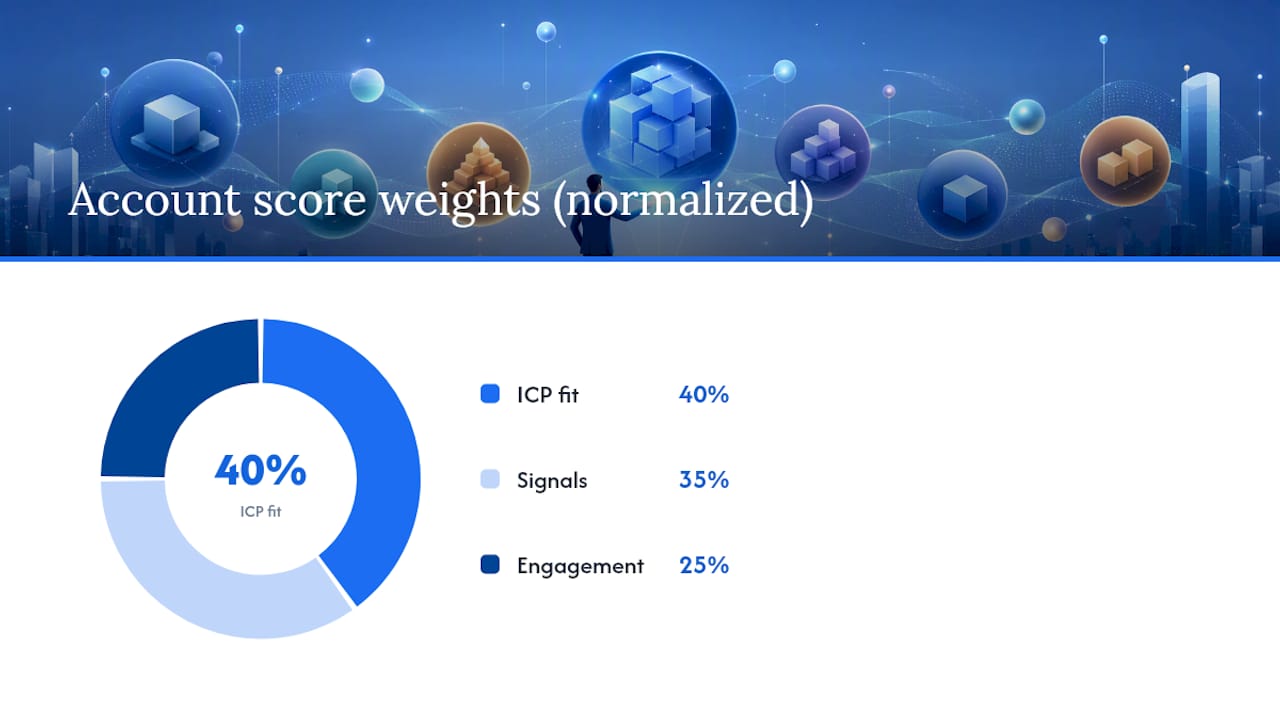
The dominant model used by high-performing revenue teams combines three layers into a single account score: ICP fit, buying signals and intent, and engagement. Each layer answers a different question, and none of them alone tells you enough to act on.
ICP fit measures whether the account looks like your best customers on paper. It draws from firmographics (employee count, revenue band, industry), technographics (what tools they already run), and org structure (do they have the buying role your product needs?). Fit is the slowest-changing layer, which is exactly why it should never carry the most weight on its own.
Buying signals and intent capture what the account is doing right now. Hiring surges, leadership changes, funding announcements, and third-party intent data (a prospect researching category terms across the web) all fall here. This layer changes weekly, sometimes daily.
Engagement tracks direct interaction with your company: pricing page visits, demo requests, multi-person attendance on a webinar, or trial activity if you offer one. Engagement is the most immediate signal but the easiest to fake with a single curious junior employee, which is why it should never stand alone either.
Salesmotion's field-tested framework recommends starting with Fit at 40%, Signals at 35%, and Engagement at 25%, then adjusting those weights against your own closed-won data over time. That starting split makes sense for most B2B teams: fit filters out accounts that will never buy no matter how loud the signals get, while signals and engagement together catch the timing.
Statistic worth building your model around: research on LinkedIn's Account Prioritizer found that pairing a machine learning ranking model with instance-level explanations for reps produced an +8.08% lift in renewal bookings during A/B testing. The lift didn't come from the algorithm alone. It came from reps trusting the ranking enough to act on it, because they could see why an account moved.
Normalization matters just as much as weighting. A $2 million enterprise account and a $40,000 SMB account shouldn't compete on raw deal size when you're scoring fit or signal strength. Score each layer on a 0 to 100 scale relative to your own base, not against absolute dollar figures, so a growing SMB with strong intent can outrank a sluggish enterprise account that fits your ICP on paper but hasn't moved in months.
Separate research on combining behavioral data with firmographic inputs, published in Frontiers in Artificial Intelligence, found that blending the two improves prediction accuracy over either input alone, which is the core argument for running all three layers together rather than picking one.
How Do You Build an Account Scoring System Step by Step?
Building a working model takes five steps, and skipping any one of them is why most scoring projects stall out in a spreadsheet nobody opens twice.
- Audit your data and assign owners. List every source feeding the model: CRM fields, first-party website analytics, intent data providers, enrichment tools. Assign a single owner for data quality on each source, because a model built on stale CRM fields will rank accounts wrong no matter how clever the weighting is. A CRM data hygiene playbook is worth running before you score anything.
- Define 3 to 8 scoring factors with clear rules. Pick factors you can actually measure consistently, such as employee count, funding stage, pricing page visits in the last 14 days, or a hiring surge in a target department. Set a decay window for each: a demo request from six months ago shouldn't count the same as one from six days ago.
- Score, normalize, and tier. Run each account through your weighted formula, normalize the results on a common scale, then sort into tiers. Cap Tier 1 at roughly 15 to 25 accounts per rep, a range Salesmotion's benchmarking points to as the sweet spot for focused coverage without spreading reps too thin.
- Map a playbook to each tier. Tier 1 gets multi-touch, multi-channel outreach and possibly executive sponsor involvement. Tier 2 gets a steady nurture cadence. Tier 3 gets marketing automation only, with a human touch reserved for when a signal fires.
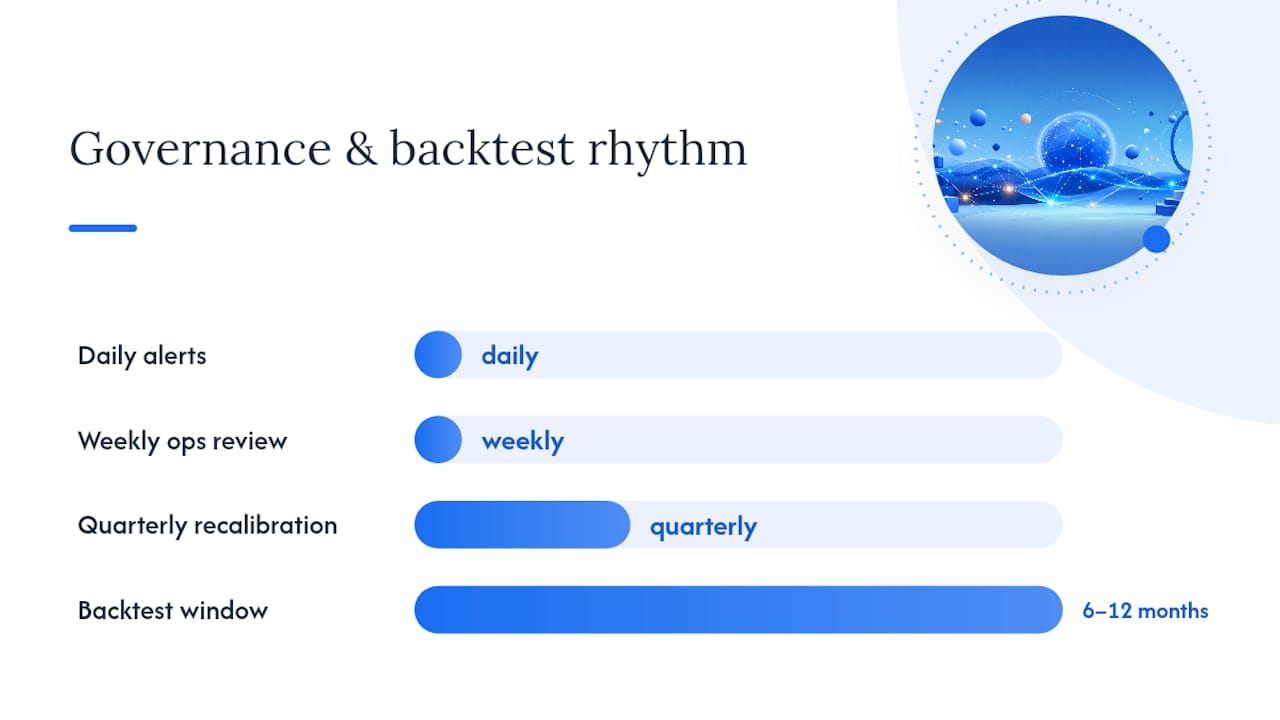
- Set a review cadence. Alerts run daily or weekly for signal changes; the model itself gets recalibrated quarterly against actual win rates.
Pro Tip: Don't build an eight-factor model on day one. Start with three factors you trust completely, prove the ranking beats gut instinct on 90 days of closed deals, then add complexity.
What Signals Actually Predict Buying Momentum?
Not every signal deserves equal weight, and chasing every available data point is how teams end up drowning in noise instead of acting on it.
First-party signals come directly from your own systems and tend to be the most reliable. Multiple people from the same account visiting your pricing page in the same week, a trial account with daily active usage, or a spike in support tickets asking about upgrade paths all point to real momentum.
Third-party signals come from outside your ecosystem: hiring announcements for roles your product supports, executive changes, funding rounds, or earnings call language mentioning initiatives your category solves for. A B2B intent data provider comparison is worth reviewing if you're deciding which third-party source to add first.
Signal hygiene is where most models quietly break:
- Recency matters more than volume. Ten website visits spread across a year mean less than two visits in the same week.
- Depth beats surface activity. A visit to the pricing page outweighs three visits to the blog.
- Apply decay windows to everything. A hiring signal from four months ago has likely already resolved into a decision one way or another.
Identity resolution and buyer-group detection multiply the value of every other signal you track. Knowing that three different people from the same account engaged in the same two weeks tells you far more about buying-committee movement than any single contact's activity ever could.
How Do You Get the Score Into Reps' Daily Workflow?
A prioritization score that lives in a separate dashboard nobody opens is worse than no score at all. The score needs to live inside the CRM fields and views reps already use, not bolted on somewhere they have to remember to check.
Practical patterns that work:
- Add the tier and score as native CRM fields, visible on the account record and in list views, not buried in a report.
- Send a morning digest summarizing accounts that moved tiers overnight or triggered a new signal.
- Push Slack alerts for high-priority stacked signals, such as a Tier 2 account suddenly showing three engagement spikes in one day.
- Automate task creation so a Tier 1 signal spawns a follow-up task assigned to the right rep automatically, rather than waiting for someone to notice.
- Route new accounts to the right SDR the moment they clear the Tier 1 threshold, and trigger a sequence built for that tier specifically.
Most high-performing teams have shifted away from quarterly, static scoring toward this kind of continuous model, where real-time alerts and CRM-visible scores replace the old habit of reviewing a spreadsheet once a month.
Adoption is the part teams underestimate. Reps ignore a black-box score. Pro Tip: Show the "why" behind every ranking, not just the number. A rep who sees "hiring surge in ops + two pricing page visits this week" will act on that account. A rep who just sees "Score: 87" will shrug and go back to their own list. Build a short feedback loop where reps can flag a ranking that felt wrong, and route those flags to whoever owns the model for the next calibration pass. Forrester's research on sales productivity consistently ties measurable gains to teams that pair CRM-centered workflows with this kind of structured feedback, not to the scoring model alone.
How Do You Know the Model Is Actually Working?
Track four metrics from day one: conversion rate by tier, pipeline velocity for Tier 1 versus Tier 2 accounts, renewal and upsell lift on accounts the model flagged early, and rep time-to-first-touch after a signal fires.
Backtesting matters before you trust any weighting scheme. Run your proposed model against 6 to 12 months of closed-won and closed-lost data and check whether it would have ranked your actual winners higher than your losers. If it wouldn't have, adjust the weights before rolling it out live. A holdout test, where one group of reps works the model's ranking and a control group works their old list, gives you a clean read on real impact.
Gartner's guidance for sales leaders points to AI and data-driven signal integration as a top strategic priority, precisely because stale, quarterly-only prioritization loses live opportunities.
Set a governance rhythm: daily alerts for signal changes, a weekly ops review of tier movement, and a quarterly recalibration where you retest weights against fresh closed-deal data. The most common failure mode is skipping that last step. Models decay as your market and product shift, and a system nobody revisits for a year quietly drifts wrong.
- Conversion by tier tells you if the ranking predicts anything real.
- Time-to-first-touch tells you if reps are actually acting on Tier 1 alerts.
- Renewal/upsell lift tells you if the model catches expansion opportunity, not just new logos.
A Practitioner's Playbook for Rolling This Out
This exact rollout has been implemented with sales and RevOps teams building prioritization from scratch, and a few specific numbers hold up across most B2B teams.
- Cap Tier 1 at roughly 15 to 25 accounts per rep. This range is often suggested as a balance between coverage and outreach quality.
- Tier 1 outreach themes center on multi-channel, multi-touch sequences tied directly to the signal that triggered the ranking, ideally with executive sponsor involvement on the largest accounts.
- Tier 2 nurture cadence runs lighter: a monthly check-in touch plus automated content matched to their fit profile, watching for any signal spike that promotes them to Tier 1.
- Workshop sessions built to align sales and RevOps typically walk through the scoring model together in the room, agree on the weighting live, and assign a data owner before anyone leaves.
Every rollout needs a data owner and a rep-feedback channel before it launches, or the model stalls within a month. and strengthen this section further once available.
Pro Tip: Run the Tier 1 cap conversation with reps before you announce the model, not after. Reps who help set the number defend it later. Reps who get handed the number resent it.
When to Prioritize Aggressively, and When to Protect Strategic Accounts
Signal-driven models are built for speed, and speed has a blind spot: strategic accounts that move slowly but matter enormously rarely trip enough signals to rank high on a pure momentum score. A model that only chases hot signals will quietly starve the accounts your business needs in three years, not three weeks.
Leadership should override the model when an account carries strategic weight the score can't see. A logo that opens a new vertical, a reference customer, or a board-level relationship justifies rep time even at a low score. Protect that capacity explicitly, don't just hope reps remember to make time for it.
The practical fix is a dedicated strategic account list running alongside the tiered model, with its own protected hours, so it never competes directly against whatever account is spiking hardest this week.
— Chad
Get Help Building and Rolling Out Your Account Prioritization Model
Building a scoring model on a whiteboard is the easy part. Getting reps to trust it, use it daily, and stick with it through the first messy quarter is where most rollouts actually die, and it's the exact gap Chadburmeister closes with sales leaders and RevOps teams. The author has extensive experience building and scaling sales teams at major companies, and brings operational rigor to helping teams turn a prioritization framework into something reps use without being told to.
An engagement typically runs through the same four steps covered in this article: auditing your current data and CRM setup, building the scoring model and weights around your own closed-won history, mapping the CRM implementation so the score lives where reps already work, and running an adoption workshop to align sales and RevOps before launch. If your team is deciding between a DIY build and outside help getting it right the first time, book a workshop or speaking engagement to walk through your specific setup, or explore the Be Extraordinary Groups program for ongoing coaching through the rollout.
Sources
- Three critical trends for sales leaders to address in the age of AI — Gartner press release
- Sales productivity resources — Forrester
- Account Prioritizer (LinkedIn) — arXiv
- Account Prioritization: How Top Sales Teams Rank and Win Their Best Accounts — Salesmotion
FAQ
What Are the Four Methods of Prioritization?
Most sales teams use some mix of value-based (revenue potential), effort-based (ease of closing), urgency-based (signal strength), and strategic-fit prioritization. Account prioritization models typically blend all four into a single score rather than picking one method in isolation.
What Are the Five Key Account Management Processes?
The core cycle runs: account audit and segmentation, scoring and tiering, playbook assignment by tier, execution with real-time signal monitoring, and quarterly review with model recalibration. Chadburmeister's workshop approach walks teams through each of these five steps hands on.
What Are the Five Priority Levels for Tasks?
In account management, this usually maps to tiers rather than task-level priorities: Tier 1 (top 15 to 25 accounts per rep, highest touch), Tier 2 (nurture cadence), Tier 3 (automation-only), Watch (recently downgraded, monitored for signal return), and Disqualified (poor fit, removed from active scoring).
What Are the Three Prioritization Methods Most B2B Teams Use?
The three dominant methods are fit-based scoring, intent or buying-signal scoring, and engagement-based scoring. Combined, these form the ICP fit, buying signals, and engagement framework that Salesmotion's model and similar practitioner guides recommend as a starting weighting.
How Much Does It Cost to Work With Chadburmeister on This?
Pricing for speaking engagements, workshops, and Be Extraordinary Groups coaching isn't published, since it depends on team size and engagement scope. Current details are available directly on the Chadburmeister site.